Can AI Reduce Bias in High-Stakes Hiring?
A shortlist for a machine learning leadership role can look objective on paper while quietly reflecting years of human assumptions: which employers signal prestige, which career paths appear credible, and which communication styles are treated as executive presence. The question, then, is not simply can AI reduce bias. It is whether organizations are prepared to design, test, and govern AI in ways that produce fairer hiring decisions.
For employers competing for specialist talent in AI, FinTech, IT, financial services, and renewable energy, the stakes are particularly high. A weak hiring process can exclude exceptional people, narrow the leadership pipeline, and create risk long before a candidate reaches the offer stage. Used with discipline, AI can improve consistency and reveal patterns that human decision-makers miss. Used carelessly, it can automate the very inequities leaders intend to remove.
Can AI Reduce Bias in Hiring?
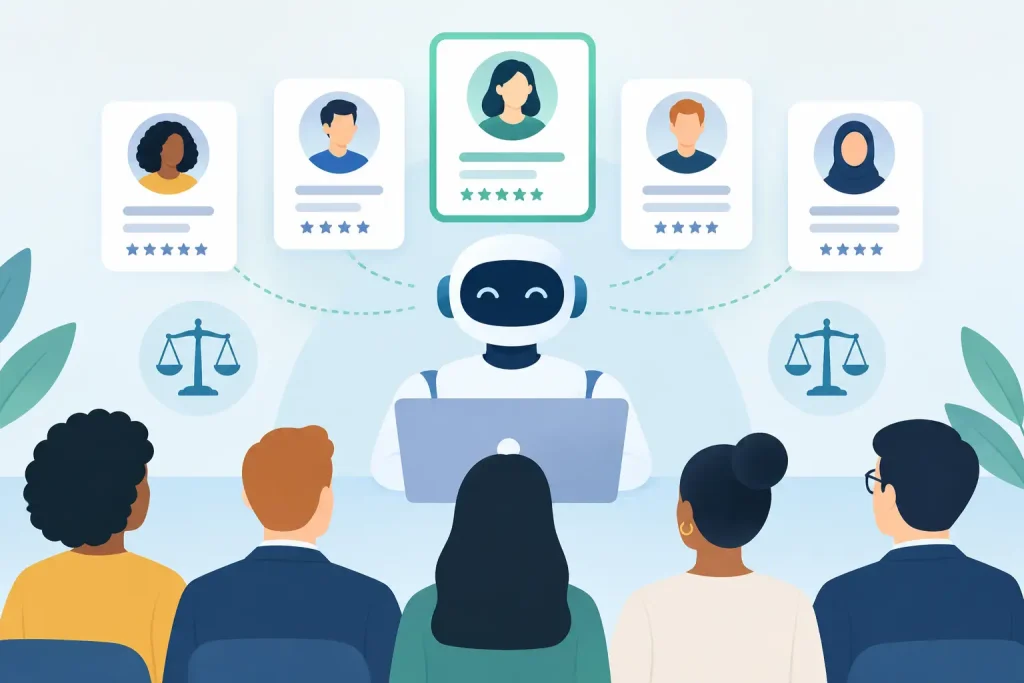
Yes, in defined parts of the process. AI can help reduce bias when it is used to standardize evaluation, focus attention on job-relevant evidence, and monitor decision patterns across the funnel. It cannot make a biased process fair by itself.
Human judgment is essential in recruitment, but it is not always consistent. Hiring teams may interpret the same résumé differently depending on a candidate’s name, school, accent, career break, previous employer, or similarity to people already on the team. Time pressure can make these shortcuts more likely, especially in competitive talent markets.
AI can introduce structure where the process lacks it. For example, a system may help remove identifying details during an initial review, compare candidates against clearly defined skills, or flag when one group is consistently screened out at a higher rate than another. These uses do not replace recruiter or hiring manager judgment. They make that judgment easier to examine.
The distinction matters. AI is most valuable as a decision-support layer, not as an unchallengeable decision-maker. In high-value hiring, cultural contribution, leadership maturity, technical depth, and career ambition still require informed human conversation.
Where AI Can Create More Consistent Decisions
The strongest applications begin with a well-defined role. If a company cannot articulate which skills, outcomes, and capabilities matter in a role, no model can reliably identify the right candidate. AI may process information faster, but it cannot correct an unclear hiring brief.
Skills-based screening
Traditional résumé screening often overweights proxies for capability, such as brand-name employers, uninterrupted career histories, or specific credentials. AI can help recruiters organize candidate evidence around demonstrated skills, project scope, certifications, technical assessments, and relevant outcomes.
This is especially useful in transformation-led sectors. A cybersecurity professional who built governance capabilities in a scaling organization may be highly relevant to a financial institution, even if their title or employer does not match a narrow historical pattern. A skills-based approach can surface that adjacent experience more consistently.
However, the model must be trained or configured to value the right evidence. If historical hires came primarily from a small set of universities or companies, an AI system that learns from those records may simply reproduce the same preference at greater speed.
Structured interviews and scorecards
AI can support interview preparation, transcription, note organization, and scorecard completion. When every candidate is evaluated against the same job-related criteria, comparisons become more defensible and less dependent on memory or rapport.
The benefit is not that AI can judge a candidate’s personality. It should not attempt to infer character, motivation, or cultural fit from facial expressions, voice patterns, or other questionable signals. The benefit is that it can help interviewers return to the evidence: Did the candidate demonstrate stakeholder management? Could they explain their technical decisions? Have they delivered results in a regulated environment?
Structured interviews also protect candidates. They create a clearer opportunity to demonstrate capability rather than requiring someone to navigate a conversation shaped by unspoken expectations.
Funnel-level pattern detection
Bias is often difficult to see in an individual decision. It becomes more visible in aggregate. AI-assisted analytics can help organizations examine progression rates from application through interview, assessment, offer, and acceptance.
A review may reveal that qualified candidates from one group regularly exit after a particular assessment, or that a sourcing channel delivers a narrow range of profiles despite a broad talent market. These insights allow leaders to investigate the process rather than making assumptions about the talent pool.
For regional and international employers, this analysis should account for local context. Talent data, legal requirements, language, educational pathways, and access to opportunity vary significantly across markets. A fairness measure that appears reasonable in one location may be incomplete or inappropriate in another.
How AI Can Amplify Bias
AI does not begin from a neutral position. It learns from data, rules, and objectives created by people. If those inputs reflect unequal access or historic preference, the output may be efficient but not equitable.
One common risk is biased historical data. A model trained on past successful employees may learn to favor profiles similar to prior hires, even when those patterns reflect past exclusion rather than future performance. Another is proxy discrimination, where seemingly neutral data points such as location, employment gaps, language patterns, or school attendance correlate with protected characteristics.
Generative AI introduces additional concerns. It can draft job descriptions, summarize résumés, and assist with candidate communications, but it can also introduce stereotypes, overstate confidence, or omit meaningful context. A résumé summary is not the candidate. Recruiters should verify the source material, particularly when assessing specialized experience or leadership potential.
There is also a human risk: automation bias. When a system presents a score or recommendation, people may give it more weight than it deserves. A polished dashboard can create an illusion of certainty. The more consequential the decision, the more essential it is that a qualified person can question, override, and document the rationale behind an AI-supported recommendation.
Building an Accountable AI Hiring Process
Responsible use requires more than selecting a vendor or adding an AI feature to an applicant tracking system. It requires operating discipline across talent acquisition, HR, legal, data, and business leadership.
Start by defining the decision the technology will support and the evidence it is allowed to use. A tool that helps anonymize résumés presents a different risk profile from one that ranks applicants or analyzes interview responses. Avoid using AI to make high-impact decisions from opaque signals that candidates cannot understand or challenge.
Then establish a practical governance standard. At a minimum, organizations should ensure that they can explain the system’s purpose, maintain meaningful human oversight, test outcomes for adverse impact, protect candidate data, and provide a clear route for review when a decision appears incorrect.
Four questions should guide any implementation:
- Is the tool measuring job-relevant capability rather than convenience-based proxies?
- Has it been tested on the populations and markets where it will be used?
- Can recruiters and candidates understand how its output informs a decision?
- Is there a documented human review process for high-impact recommendations?
Testing cannot be a one-time event. Job requirements change, candidate markets shift, and models may behave differently as new data enters the system. Regular audits should assess not only technical performance but also candidate experience, progression rates, and the quality of eventual hires.
Organizations should also be transparent without overwhelming candidates with technical detail. People deserve to know when AI materially supports screening or assessment, what information is being considered, and how they can ask questions. Transparency strengthens trust, particularly when hiring for roles that will shape an organization’s technology, financial, or energy transition strategy.
The Human Standard Still Sets the Outcome
The most effective hiring processes combine technology with informed, accountable judgment. AI can reduce administrative burden, widen the search for relevant talent, and bring greater consistency to how evidence is reviewed. It cannot define a fair hiring philosophy, create psychological safety in an interview, or build a relationship with a candidate deciding between career-defining opportunities.
For employers, this is where a specialist talent partner adds value. Market knowledge helps distinguish a truly scarce skill from an unnecessarily narrow requirement. Structured consultation helps clarify what success looks like beyond a job title. And human-led engagement ensures that candidates are assessed as professionals with context, potential, and ambitions – not as a score.
The future-ready question is not whether to use AI in recruitment. It is whether every use of AI makes the process more transparent, more consistent, and more respectful of the people whose careers it affects. Organizations that hold themselves to that standard will make better hiring decisions and build stronger teams in the process.
Building a fairer, more accountable hiring process? See our executive search and recruitment services or get in touch.