AI Recruiters vs Generalists: What Changes?
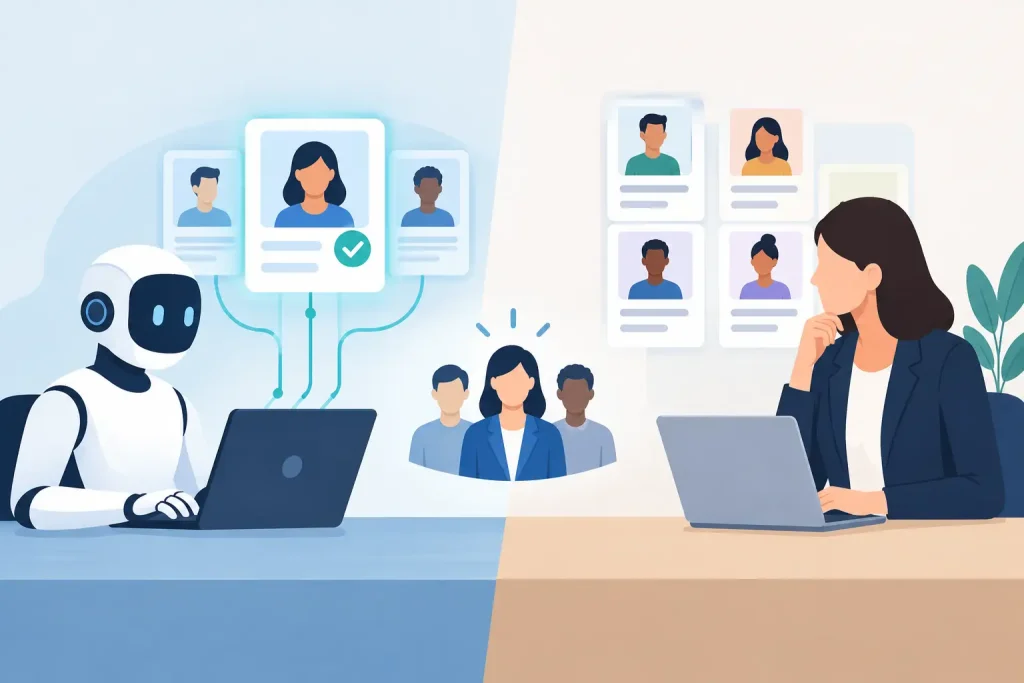
A delayed AI hire rarely stays contained to one vacancy. It can slow a product roadmap, place more pressure on an already stretched engineering team, or leave a business without the leadership required to turn experimentation into commercial value. That is why the question of AI recruiters vs generalists is not simply about who can source a resume fastest. It is about whether a hiring partner can recognize the capabilities, context, and motivation behind the profile.
For organizations building future-facing teams, recruitment is a strategic decision. The right recruiter helps leaders make better judgments under pressure: which skills are truly essential, where the market is moving, what compensation will attract the right person, and whether a candidate can succeed in the environment being created. A generalist may provide broad coverage. An AI specialist provides a more informed route to a hire that can create lasting impact.
AI Recruiters vs Generalists: The Core Difference
Generalist recruiters are designed to work across functions and industries. Their breadth can be valuable for organizations with recurring, standardized hiring needs or roles where technical depth is not the primary assessment challenge. They often maintain large candidate databases and can move quickly when the brief is clear and the talent pool is broad.
AI recruitment is different. The discipline changes quickly, job titles are inconsistent, and technical language can conceal major differences in capability. A candidate who has worked with machine learning may not have deployed models in production. Someone with experience in generative AI may be highly effective at prototyping but lack the engineering discipline needed for governance, evaluation, or scale. A strong AI recruiter understands the distinction before a shortlist reaches the hiring manager.
That knowledge affects every stage of the search. It shapes the intake conversation, the talent map, the outreach message, the initial qualification, and the advice given to candidates and employers. Rather than matching keywords to job descriptions, a specialist tests for relevance to the business problem.
Why AI Hiring Demands More Than a Broad Network
A broad network is useful. It is not, by itself, a hiring strategy. The most sought-after AI professionals are often not actively applying for jobs, and many are selective about the problems they solve, the data they can access, and the level of executive commitment behind an AI initiative.
Specialist recruiters can have more credible conversations with these professionals because they understand the work. They can discuss whether a role involves building recommendation systems, improving model operations, establishing responsible AI standards, or leading an enterprise-wide transformation program. This creates a more accurate match and protects an employer’s reputation in a small, connected talent market.
The distinction is especially meaningful for leadership roles. Hiring a Head of AI, VP of Data, or AI product leader requires more than confirming management experience and technical credentials. The recruiter needs to evaluate the candidate’s ability to set priorities, influence nontechnical stakeholders, build a team, and connect technical investment to commercial outcomes. Those are not interchangeable skills.
Titles can be misleading
AI talent does not fit neatly into a universal title structure. A machine learning engineer at a global technology company may have very different responsibilities from one at a financial institution or early-stage startup. A data scientist may focus on analytics in one organization and model development in another. A generalist search can mistake title familiarity for functional fit.
Specialist recruiters begin with the operating context. They ask what the business expects the hire to deliver in the first 12 months, what systems and data foundations already exist, who owns decision-making, and where the role sits between product, engineering, risk, and commercial leadership. This turns a job description into a search strategy.
Technical fit must be commercially relevant
The strongest candidate is not always the person with the longest list of tools. For a FinTech company, experience with fraud detection, model monitoring, regulatory expectations, and sensitive customer data may matter more than exposure to every new framework. For a renewable energy business, forecasting, optimization, and industrial data experience may carry greater weight. For a family office exploring AI, the priority may be a leader who can establish governance and identify practical use cases before building a large team.
A sector-focused recruiter can translate those realities into a sharper assessment process. This is where specialization becomes a commercial advantage, not a niche preference.
Where Generalist Recruitment Still Has a Place
The comparison should not suggest that generalists have no role in an AI-enabled organization. They can be effective when hiring is high-volume, the role is well defined, or the organization needs support across several nontechnical functions at once. A growing business may reasonably use a generalist partner for operations, sales, administration, or early-career hiring while reserving specialist support for critical technical and leadership positions.
The risk appears when a high-consequence AI brief is treated like a standard vacancy. If the recruiter cannot challenge an unrealistic job specification, distinguish adjacent skills, or explain why top candidates may hesitate, the process can create false momentum. A large slate of resumes may look productive while producing very few credible finalists.
The best model is often deliberate rather than exclusive. Employers can use generalist capacity for breadth and specialist expertise where precision matters most. The question is not which model is universally better. It is what level of market intelligence the role demands.
The Cost of Getting the Brief Wrong
AI hiring failures often begin before sourcing. An organization may request a single person who can design strategy, build models, manage infrastructure, lead product delivery, establish governance, and recruit a team. That profile may exist, but it will be rare, expensive, and unlikely to move without a compelling mandate.
A specialist partner can help leaders separate immediate needs from future ambitions. Perhaps the first hire should be an AI product leader who can prioritize use cases. Perhaps it should be a machine learning engineer supported by an external data partner. Perhaps the company needs a data governance lead before it needs an AI team at all.
This consultation saves time, but it also improves retention. Candidates leave when the role they accepted differs from the role they encounter. Clear expectations, realistic scope, and strong stakeholder alignment create the conditions for performance after placement.
For candidates, the same principle applies. A specialist recruiter should not present an opportunity merely because the title appears to be a step up. They should explain the maturity of the AI function, the decision-making environment, the available resources, and the risks attached to the mandate. Career progression is strongest when the role expands both impact and capability.
What Employers Should Expect From an AI Specialist
A credible AI recruitment partner should bring evidence, not just enthusiasm for a fast-moving field. They should be able to explain how they define the target profile, which adjacent talent pools they will assess, and what conditions will make the opportunity competitive.
They should also ask demanding questions. What business outcome is this hire accountable for? Is the executive team aligned on the value of AI? Does the organization have usable data, appropriate infrastructure, and clear governance? What does success look like after six and 12 months? A recruiter who asks these questions is protecting the quality of the hire.
At Infinite People, this perspective is central to recruitment in AI and other transformation-led sectors. The objective is not simply to fill a role. It is to connect organizations and professionals where technical capability, cultural alignment, and long-term ambition can move forward together.
Choosing the Right Recruitment Partner
The decision should reflect the strategic weight of the role. For a specialized AI, data, or technology appointment, look beyond database size and promised turnaround time. Evaluate the recruiter’s understanding of your sector, the quality of their qualification process, their ability to engage passive candidates, and the clarity of their market advice.
For employers operating across the Middle East, Africa, and internationally connected markets, regional insight adds another dimension. Compensation expectations, talent mobility, regulatory considerations, and cultural leadership styles can all influence whether a strong candidate accepts and stays. A recruiter with local relationships and global perspective can position an opportunity with more credibility.
For professionals, choose a recruiter who can articulate why a role fits your trajectory, not simply why it is available. The right conversation may challenge your assumptions, clarify your value in the market, and help you assess whether an employer is genuinely prepared to invest in the work it wants you to lead.
The next AI hire should not be treated as a race to collect resumes. Treat it as an opportunity to define the capability your organization needs next, then partner with someone equipped to recognize it in the market.