
AI Talent Acquisition Strategy That Works
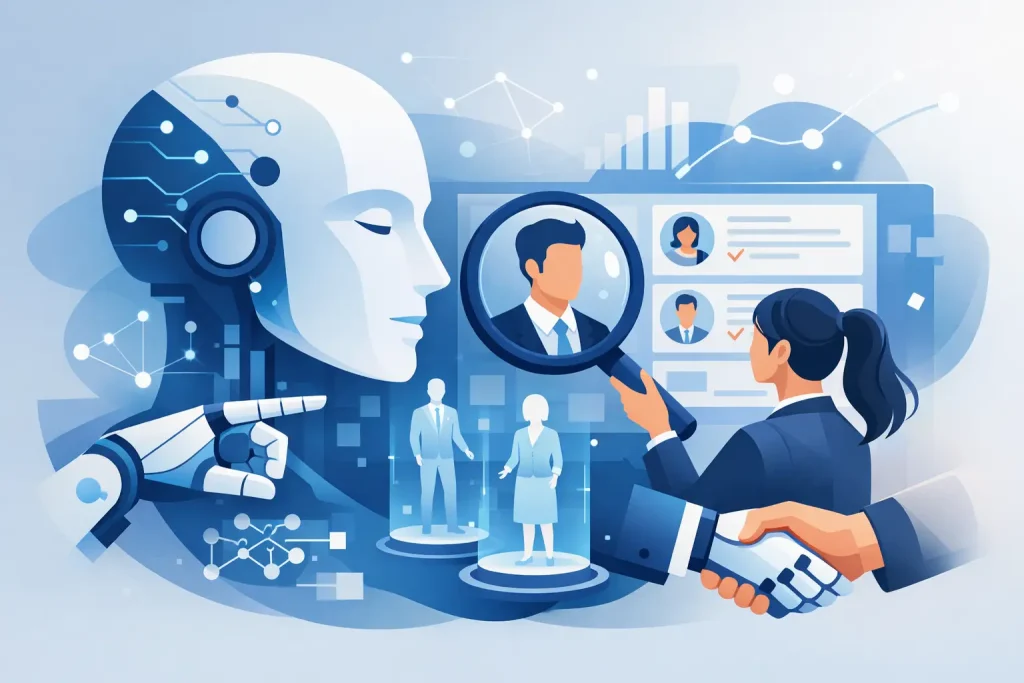
A hiring team can buy the latest sourcing platform, automate outreach, and screen thousands of profiles in hours – then still miss the one candidate who can actually build, lead, or scale the function. That is the central challenge in any ai talent acquisition strategy. The technology can widen the funnel and compress timelines, but it cannot replace judgment about context, capability, and long-term fit.
For employers hiring in AI, IT, FinTech, financial services, and renewable energy, the stakes are higher than usual. Many roles are new, talent pools are tight, and the cost of a poor hire goes well beyond recruiter fees or time-to-fill. It affects product delivery, regulatory confidence, team credibility, and often investor perception. A strong strategy, then, is not about adding AI to recruiting for its own sake. It is about deciding where machine intelligence improves outcomes and where human expertise must stay firmly in control.
What an AI talent acquisition strategy actually means
At its best, an AI talent acquisition strategy is a hiring framework that uses data, automation, and predictive tools to support better talent decisions across the recruitment lifecycle. That includes workforce planning, sourcing, screening, scheduling, assessment, candidate engagement, and post-hire analysis.
What it does not mean is handing over hiring to software. In specialist markets, the most valuable hiring decisions are rarely simple pattern matches. A machine may identify relevant keywords, compensation benchmarks, and likely responsiveness. It may even surface adjacent talent from overlooked sectors. But it cannot fully interpret why a Head of Risk from one financial institution will thrive in a scaling FinTech while another will struggle, even with an almost identical resume.
That distinction matters. Too many organizations treat AI as a shortcut to volume when the real commercial value lies in precision.
Why AI is changing talent acquisition now
The pressure is coming from three directions at once. First, hiring teams are expected to move faster, even as roles become more specialized. Second, candidates now expect a smoother and more tailored process. Third, leadership teams want hiring to be more measurable, with clearer links between recruitment activity and business performance.
AI helps because it can process far more information than any individual recruiter or hiring manager. It can identify search patterns, rank profiles, automate repetitive communication, and flag bottlenecks in the funnel. For organizations expanding into future-facing sectors, that creates an operational advantage.
Still, speed without calibration creates risk. If the underlying data is biased, incomplete, or drawn from yesterday’s workforce, AI can simply scale flawed assumptions. That is why the most effective strategies are not tool-led. They are operating-model led.
Building an AI talent acquisition strategy around business goals
The first question is not which platform to buy. It is what business problem you are solving. If your issue is chronic time-to-hire for software engineers, the strategy will look different than if the issue is low retention among senior commercial hires or inconsistent shortlists across markets.
A useful starting point is to map recruitment against business priorities for the next 12 to 24 months. Are you entering a new geography? Building a leadership bench? Replacing expensive agency dependence with stronger internal capability? Hiring in regulated sectors where technical skill alone is not enough? Your AI approach should reflect those realities.
For example, automation may create immediate value in interview scheduling and candidate communications, where delay often damages candidate experience. In contrast, for executive search or highly confidential hiring, AI may play a lighter support role while relationship-led assessment remains central.
That is one reason a mature ai talent acquisition strategy is usually blended. High-volume tasks benefit from automation. High-impact decisions require specialist human evaluation.
Where AI adds the most value in hiring
Sourcing is often the clearest win. AI can analyze large talent pools, infer adjacent skills, and identify passive candidates who may not appear in traditional searches. In sectors where job titles vary widely, that flexibility matters. A machine-learning engineer, quantitative analyst, and data platform architect may share relevant capability even if their profiles are labeled differently.
Screening can also improve when used carefully. AI tools can help prioritize applicants against predefined criteria, reduce manual review time, and improve consistency. But the criteria themselves need scrutiny. If a company has historically hired from a narrow range of institutions or employers, training a model on that history can reinforce exclusion rather than quality.
Candidate engagement is another practical use case. Automated updates, intelligent chat support, and timely scheduling reduce friction in the process. This does not sound transformational, but in talent-short markets, responsiveness influences acceptance rates more than many employers realize.
The most strategic use, though, is insight. AI can help organizations understand where strong hires come from, which stages produce drop-off, which competencies correlate with retention, and where compensation or process design is undermining offer acceptance. That turns recruitment from an administrative function into a source of workforce intelligence.
The risks leaders should not ignore
The strongest case for AI in hiring is also the strongest reason to govern it carefully. Hiring decisions affect livelihoods, brand reputation, diversity outcomes, and regulatory exposure. If an AI model screens out qualified candidates unfairly, the cost is not abstract.
Bias is the most discussed risk, but it is not the only one. Explainability matters. If a hiring manager cannot understand why a tool ranked one candidate above another, confidence erodes quickly. Data privacy is equally important, especially when candidates are moving across borders or being considered for sensitive sectors.
There is also a quieter risk: dehumanization. High-value candidates do not want to feel processed. Senior professionals, niche technical talent, and commercially valuable movers expect discretion, relevance, and genuine engagement. If AI creates a colder experience, employers may lose exactly the people they most want to hire.
That is why governance should sit inside the strategy from the start. Define which decisions can be automated, which require human review, how fairness is tested, and who is accountable when the system underperforms.
How to implement AI without losing the human advantage
The most effective organizations phase adoption. They begin with areas where operational gains are clear and risk is relatively low, then expand as confidence grows. Scheduling, pipeline reporting, sourcing support, and candidate communications are often sensible early steps.
Next comes process design. Standardize job requirements, scorecards, and interview criteria before layering in AI. If the hiring process is inconsistent, technology will magnify that inconsistency rather than solve it.
Training also matters more than many leaders expect. Recruiters and hiring managers need to understand what the tools are doing, where they can add judgment, and when to challenge the output. AI should sharpen recruiter capability, not deskill it.
This is especially relevant in specialist sectors across the Middle East and Africa, where market nuance, mobility considerations, compensation structures, and cultural fit often shape outcomes as much as technical match. A purely automated model will miss signals that an experienced sector recruiter can interpret quickly.
For that reason, many employers benefit from working with a partner that understands both the technology and the talent market. Firms such as Infinite People are positioned around that intersection: digital intelligence supported by deep sector knowledge and relationship-led assessment.
What success looks like in practice
A successful AI-enabled hiring function does not just fill roles faster. It improves quality of hire, strengthens retention, and gives leadership better visibility into talent risk. Those outcomes are measurable, but they rarely come from one tool alone.
Look for signs of maturity instead. Recruiters spend less time on repetitive admin and more time advising the business. Hiring managers receive shorter, stronger shortlists. Candidates move through the process with greater clarity. Diversity outcomes are tracked rather than assumed. Post-hire data is used to refine future searches.
There will be trade-offs. More automation may increase efficiency but reduce warmth if not designed well. Tighter screening may improve relevance but shrink diversity if criteria are too rigid. More data can support better decisions, but only if the organization knows how to interpret it.
That is why the right strategy is rarely the most automated one. It is the one that aligns technology, process, and human judgment around the roles that matter most.
The next phase of AI talent acquisition strategy
The conversation is already moving beyond simple automation. More employers now want predictive hiring models, skills-based workforce planning, and better alignment between recruitment, internal mobility, and retention. In other words, talent acquisition is becoming part of a broader talent intelligence function.
That shift creates opportunity for organizations prepared to invest thoughtfully. The winners are unlikely to be those with the loudest technology stack. They will be the ones that use AI to make hiring more informed, more responsive, and more aligned to business growth – while still treating candidates as people, not data points.
For employers building future-ready teams, that is the real test of an ai talent acquisition strategy: not whether it feels advanced, but whether it helps you identify the right people, engage them well, and build lasting capability in a market where talent decisions shape the future of the business.